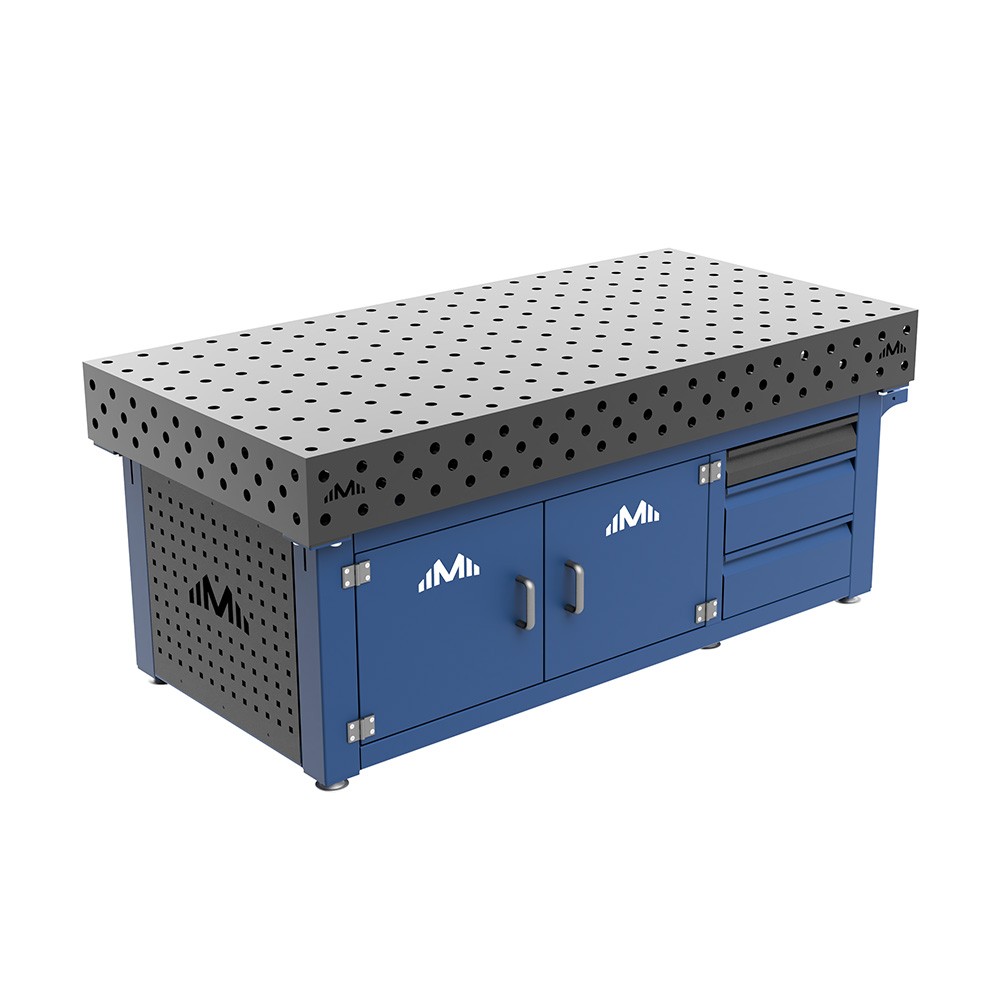
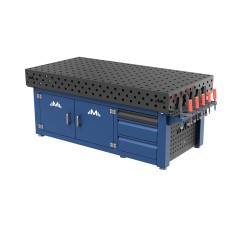
2000×1000 Workstation System 16/28 – compact size, professional precision
The 2000×1000 model is a workstation designed for workshops that require the full functionality of system tables in a more compact and easy-to-place size. The 2000×1000 mm working surface ensures convenient work with medium-sized structures while allowing you to optimize the layout of your hall or garage. It’s a perfect solution for welders, locksmiths, assemblers, and prototyping workshops that value repeatability, quick setup, and uncompromising rigidity. The table is available in two clamping standards – 16 mm or 28 mm – making it easy to match your existing accessory sets.
Why choose the 2000×1000 format
The main advantage of this version is the balance between size and structural stability. The 15 mm thick tabletop works on a dense grid of 185 mm ribs, while 200 mm side profiles create a rigid "frame" that transfers loads without wobbling. The tabletop’s flatness tolerance is a maximum of 0.5 mm across the entire surface, so jigs and base elements maintain geometry even during long welds. With a load capacity of up to 2800 kg, the station safely handles heavier machine components, assembly tables, and measuring fixtures.
The precise 100×100 mm engraved grid makes it easier to quickly position components, and the chamfered system holes protect pins and stops from burrs. Choosing between the 16 mm and 28 mm systems allows you to perfectly adapt your clamping setup – from light fixtures for thin sheets and profiles to heavy-duty setups for thick-walled structures. In practice, this means repeatable settings, shorter setup times, and fewer corrections after welding.
Work organization without compromise
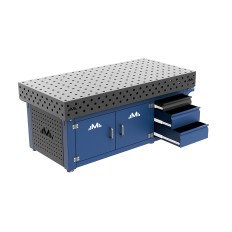
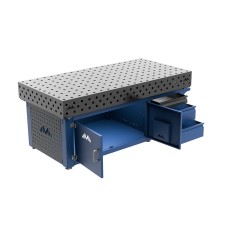
In daily use, the tabletop is just the beginning. The workstation is designed as a complete work center – with four spacious drawers for accessories, measuring tools, nozzles, and small components, plus a dedicated clamp holder to keep frequently used tools always at hand. A separate mobile container allows you to move your toolset wherever you work without repeatedly assembling or rearranging equipment. The working height is adjustable within the typical workshop range of approx. 850–950 mm, improving ergonomics during long tasks and reducing operator fatigue. The entire structure is finished with a durable RAL 5005 coating, resistant to impacts and spatter.
16/28 clamping platform built to last
The system holes are positioned with strict dimensional accuracy, and their edges are chamfered to allow pins to slide in smoothly and avoid burrs even after hundreds of setups. This small detail makes a huge difference over time – tooling wears out more slowly, and positioning remains repeatable. The 100×100 mm engraved grid acts as a common “language” across the entire table: you plan setups, transfer them between projects, and recreate them without extensive marking. The structure, based on four ribs (185 mm) and high side walls (200 mm), ensures safety under larger components, and the table’s mass stabilizes the platform even during dynamic operations.
Process efficiency: shorter setup, fewer corrections
The 2000×1000 mm station was designed to shorten preparation time. In practice, the process looks like this: receive the part, align it with the 100×100 grid, insert stops and pins in the 16 mm or 28 mm standard, lock with clamps from the holder, and work. Thanks to the flat, even tabletop and rigid rib support, welds do not distort the structure, so final corrections are minimal. This directly translates to consistent quality and lower labor costs – the table simply helps keep the process under control.
Finish and durability of the structure
Materials and processing are selected for long-term use: 15 mm thick tabletops, precision-machined holes, permanent grid engraving, and RAL 5005 powder coating. Flatness tolerance up to 0.5 mm and load capacity up to 2800 kg are parameters typically found in high-end tables – here, you get them in a compact size that’s easier to integrate into your existing workspace. If you expand your workstation in the future, compatibility with 16/28 system accessories allows you to scale up without replacing your entire infrastructure.
Who is the 2000×1000 size for?
If your projects rarely exceed 2 meters in length and you want to save workshop space, this workstation is the perfect balance. It can easily handle frames, baskets, supports, shorter profile sections, and sheet metal components – all without forcing you to reorganize your entire workspace. It’s also an excellent choice as a second table for preparation tasks, where repeatability and quick changeovers are key.
FAQ
What is the difference between the 16 and 28 systems, and which should I choose for 2000×1000?
The 16 mm system uses smaller holes and tooling – fast and precise for thin sheets, light structures, and prototypes. The 28 mm system offers greater rigidity and is better suited for heavier components. If you work with mixed production, choose the system that matches your existing accessories or the ones you plan to purchase first.
What load can the table realistically support?
The structure’s load capacity is up to 2800 kg, with stiffness provided by 200 mm side walls and four 185 mm ribs. In practice, you can safely secure heavier modules and auxiliary devices, provided the weight is evenly distributed.
How is flatness maintained over time?
The tabletop’s flatness tolerance is up to 0.5 mm across the entire surface and remains stable thanks to the solid construction and dense support. Keeping the table clean, regularly removing spatter, and working with chamfered holes significantly slows down wear.
Can I connect the workstation with other tables?
Yes. The engraved 100×100 mm grid and standardized system holes allow the workstation to be connected with other modules and 16/28 system accessories, creating larger workstations or assembly lines.
What equipment is included with the workstation?
The workstation is ready to use "out of the box": you get four drawers for accessories, a clamp holder, and a mobile container for transporting tools. The working height can be set within the typical range of approx. 850–950 mm, and the RAL 5005 coating protects the structure against corrosion.


 English
 Polski
 Français
 Slovak
 Nederlands