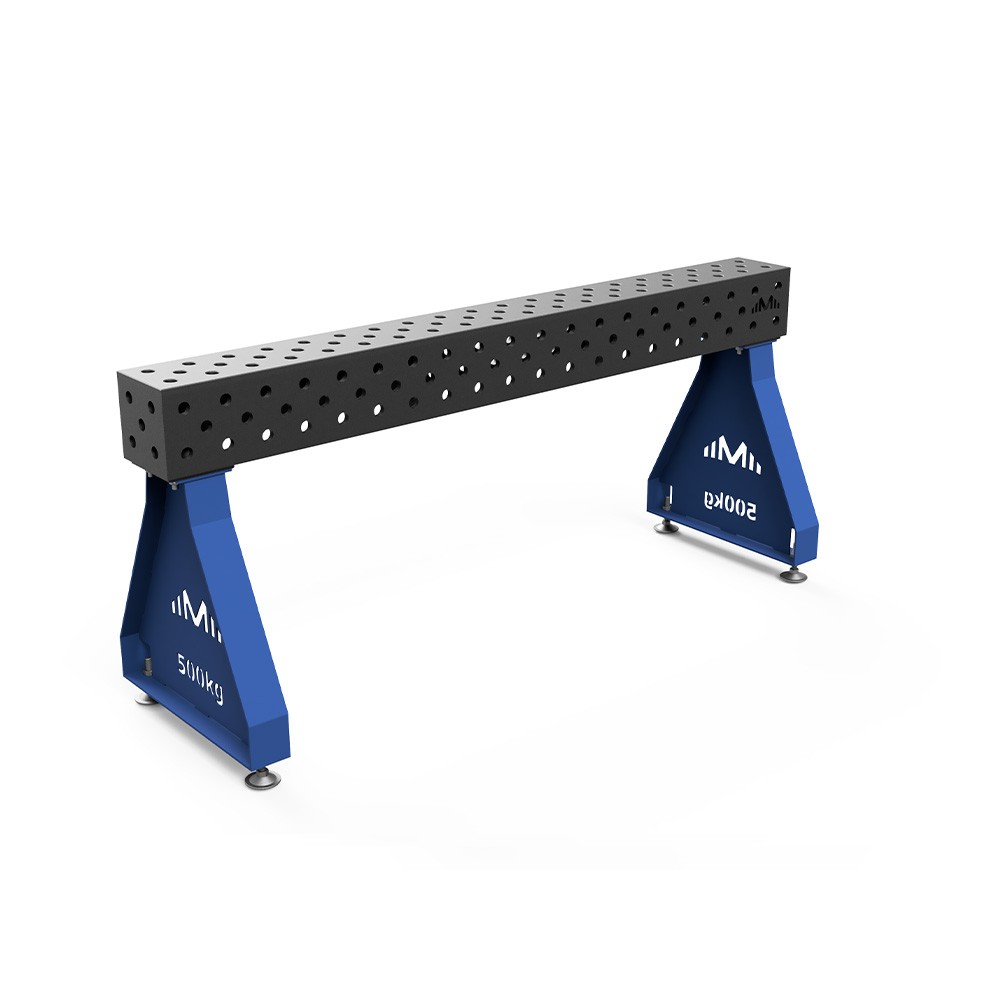
Welding Support 2000 mm – Lightweight and Stable Base for Long Workpieces
The 2000 mm support with a 12 mm plate was designed for working with profiles, frames, and structural sections that require even support far from the main table. The thinner plate makes the element lighter and easier to move, while still providing the stiffness needed to guide long workpieces along the axis. It serves as a practical “table extension” that stabilizes material during tack welding, joining, and continuous welds.
How It Works Within the Station Setup
Position the support in line with the work area, match its height with the table, and lock the adjustment mechanism. From that moment, the support carries the weight of the workpiece and keeps it at a constant height, eliminating the “sagging” effect when moving elements. Consistent level across the length means fewer stresses and fewer uncontrolled deformations during heating, which directly translates to smoother penetration and cleaner weld geometry.
Ease of Adjustment and Repeatability
The lighter 12 mm plate makes quick adjustments easier, especially when working alone and frequently moving the support between stations. At the same time, the rigid construction prevents “springing,” so the workpiece stays stable without constant correction. In series production, you’ll appreciate the ability to set fixed positions in the hole grid—once prepared, the setup can be repeated in subsequent cycles without guesswork.
Compatibility with Hole Systems and Accessories
The support is available in variants matched to popular system table grids, allowing the use of standard pins, clamps, and stops without modifications or adapters. This is important in halls where multiple stations operate in parallel—accessories remain consistent, and the operator doesn’t waste time adapting equipment.
Long and Slender Elements – Full Control
The biggest benefits come with thin-walled profiles, pipes, and beams that tend to distort under heat. Even support along 2000 mm reduces twisting and warping, keeping the weld line predictable from start to finish. For elements with varying stiffness, add a second support or auxiliary stops to distribute loads evenly and prevent localized deflections.
Faster Work Organization
Instead of improvised props from profiles or blocks, you get a tool designed for maintaining level. A tidy workstation shortens setup time and reduces the number of corrections after cooling. The operator can focus on weld quality rather than constantly checking height and alignment.
How to Unlock the Potential of the 12 mm Support
In practice, it works best as a flexible table extension—lightweight, quick to reposition, and ready for different dimensions. For long material sections, arrange the supports to define a straight guiding line. If the workpiece has uneven mass along its length (e.g., welded inserts), distribute clamps so that the main forces pull the element along the axis rather than pushing it off alignment.
Immediate Benefits
Introducing the 2000 mm (12 mm) support into the process instantly improves repeatability and predictability, especially in small and medium series. Less improvisation means fewer errors and simpler quality control.
- Stable long support – cleaner weld geometry,
- Easier positioning thanks to the lighter 12 mm plate,
- Shorter setup time and fewer corrections.
Practical Tips
First align the support with the table, then set clamps and stops. For very long elements, consider using two supports—placed evenly—to distribute weight and prevent the free end from sagging. Regularly clean the working surface from spatter; apply a thin layer of anti-spatter agent in exposed zones to keep the contact surface smooth. Store the support in a dry place to preserve precision over time.
FAQ – Frequently Asked Questions
What is the 2000 mm, 12 mm welding support used for?
It provides stable support and guidance for long workpieces; it acts as a table extension that maintains level and takes on the weight of the element.
What’s the difference between the 12 mm and 15 mm versions?
The 12 mm model is lighter and easier to move, speeding up station setup; it still provides sufficient stiffness for typical long profile work.
Does it work with system tables?
Yes, it comes in variants adapted to popular hole grids, so you can use standard pins, clamps, and stops.
How to avoid deformation during heating?
Distribute clamping points along the weld line, and for very long elements add a second support or stops to spread loads evenly.
Is it suitable for series production?
Yes. Fixed positions in the grid and quick height adjustment shorten preparation time and make repeatability easier.


 English
 Polski
 Français
 Slovak
 Nederlands