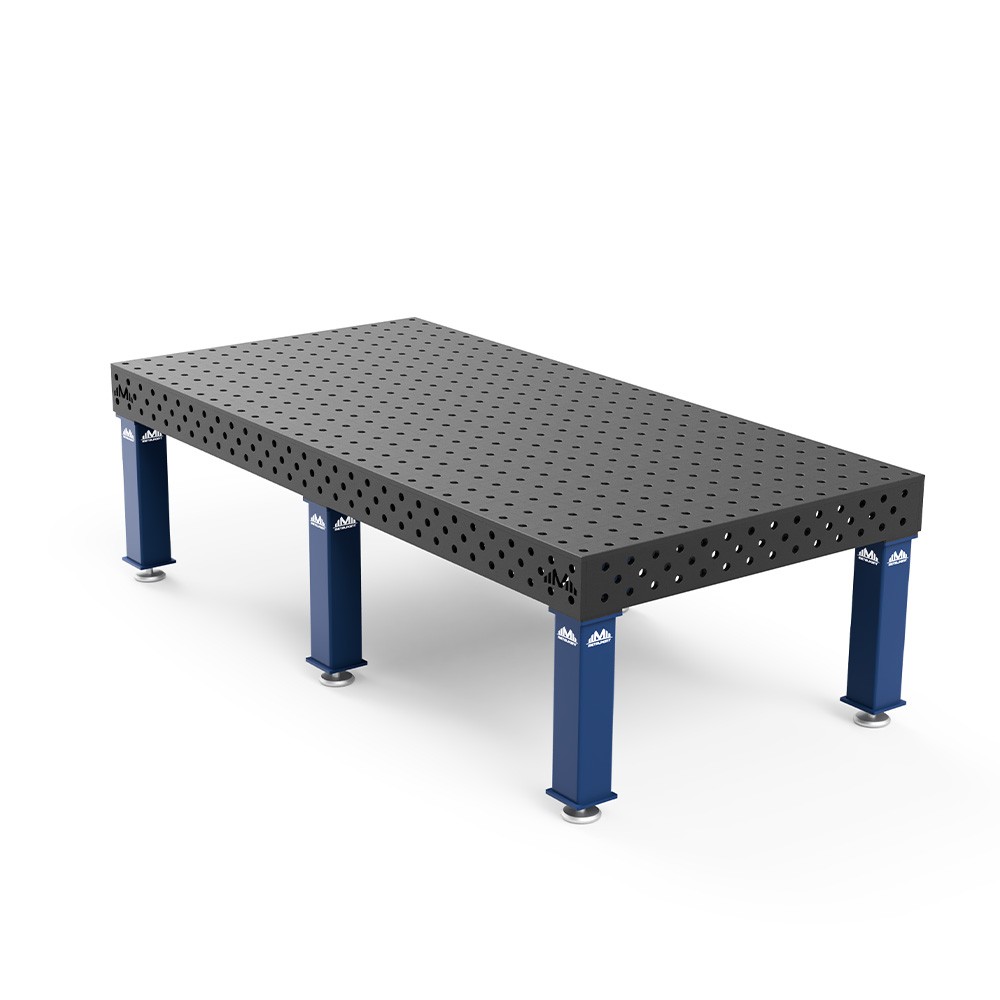
Welding table 2990x1490 system 28 - 20 mm top and load capacity 5500 kg
This Metalpoint welding table in real size 2990x1490 mm is a solution designed for heavy production work, where repeatability, stability and accuracy of detail referencing are important. The combination of the 28 mm hole system with the engraved 100x100 mm grid gives a very convenient working "language": you quickly set the element, keep the dimensions, and in the case of serial details you immediately return to the same reference points. This is a type of table that is not intended for "light construction", but for real welding and assembly of heavy components.
The key parameter here is tabletop thickness 20 mm and flatness tolerance max 0.5 mm throughout . In practice, this means that you can base details on the table without stress and build the process for preparation, without constantly correcting the geometry. The working height 850–900 mm allows you to adjust the ergonomics to the workstation, and the entire structure is prepared for long work cycles, also under conditions of high mechanical and thermal loads.
28 mm hole system and 100x100 grid – quick homing and repeatability
Hole diameter 28 mm is the standard for heavier fastening equipment and more demanding applications. Additionally, you have an engraved 100x100 mm grid , which makes it easier to set the details by eye and shortens the time of the first assembly. If you work with instruments or frequently return to the same structures, the grid greatly improves the organization of your work - instead of measuring from scratch each time, you use clear reference points.
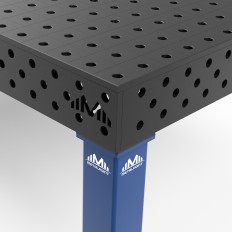
This model also uses holes in the sides in a diagonal arrangement . This is a practical addition when you want to attach elements to the side of the table, support long details or build fixtures that "extend" beyond the tabletop. Sides with a height of 200 mm provide a stable working zone for accessories and side clamps.
Reinforcements, ribs and legs - construction for heavy loads
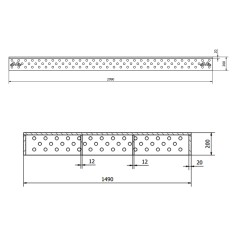
The table has a load capacity of 5,500 kg and this is not a "marketing" value - it results directly from the geometry of the structure. 7 ribs (12 mm) with a height of 180 mm were used, which work as reinforcement of the entire board and limit deflections in heavy details and during intense pressure. The whole thing stands on 6 legswith a cross-section of 140x140 mm, which ensures very good stability and weight distribution.
In practice, this arrangement works well when large, welded structures, frames, machine elements or large-size sets are placed on the table. It is also a good choice if you want a station that will withstand years of work in production without "floating" geometry and without the need for constant adjustments to settings.
Ergonomics and work in process – when pace counts
With tables of this class, what matters is not only the stiffness, but also the comfort of work during the process. Adjustable height range850–900 mmallows you to adjust the station to the operator and the nature of the work. This is important for series welding: less fatigue, better weld control and more stable repeatability, especially during longer shifts.
The weight of the table is 1200 kg, which is an advantage in this segment - the large mass improves vibration damping and "calms down" work with heavy pressure or intensive assembly. If in your plant the table is to be the basis of the process, and not just a "welding table", this parameter really helps.
The most important parameters in practice
To be specific - this is the table you choose if you want to combine stiffness, precision and fast positioning. The strongest points of this model are:
- Tabletop 20 mm + flatness max 0.5 mm - stable base for the process and preparation.
- 28 mm system + 100x100 grid - quick setting and easy return to the same points.
- Load capacity 5500 kg, 7 ribs and 6 legs 140x140 - design for heavy details and pressure.
Who is this solution for?
This model is for companies that do not want to compromise: production of steel structures, welding of frames, assembly of large elements, construction of instrumentation, service work on heavy modules. If your station is to be repeatable, fast and "without surprises", and is to withstand long cycles, this is exactly the direction.
If you want, you can send information about what mounting accessories you have or plan to have (e.g. angles, stops, clamps, pins) - then I will adapt the description to the real process and tell you what sets for the 28 mm system make the biggest difference in production.
FAQ – frequently asked questions
Is 2990x1490 mm the working dimension of the table?
This is the actual dimension of the table. This makes it easier to plan logistics, space in the hall and adaptation to existing stations and technological lines.
What are the benefits of a 100x100 mm mesh engraved on a countertop?
The grid makes it easier to quickly reference details and repeat settings. When working in series, it shortens the preparation time and reduces the number of positioning errors.
What are the holes in the sides in a diagonal arrangement for?
They allow you to attach elements to the side of the table, support long details and build fastenings extending beyond the outline of the tabletop. This is practical for large structures and unusual details.
Does a flatness of 0.5 mm throughout have any real significance in welding?
Yes - it affects repeatability, homing accuracy and process stability. For jigs and larger details, the difference in flatness translates into easier assembly and fewer adjustments.
What is the load-bearing capacity and what provides it in this structure?
The load capacity is 5500 kg. The system of reinforcements is responsible for this: 7 ribs (12 mm) with a height of 180 mm and 6 legs 140x140 mm, which stabilize the entire structure.


 English
 Polski
 Français
 Slovak
 Nederlands